
Installing Solar Panels on Different Roof Types: What Homeowners Need to Know
Not every roof is ready for solar panels, and finding that out too late can turn an exciting upgrade into an expensive mistake. Maybe you're looking for lower energy bills, planning home improvements, or simply wondering if your current roof can support a solar system for the next 25 years. Before you invest thousands of dollars, it's important to know whether your roof is actually working for you or against you.
The good news is that solar panels can be installed on many roof types, including asphalt shingle, tile, slate, flat, and metal roofs. But each roof comes with its own challenges, installation methods, and long-term costs. A setup that works perfectly on one home may not be the best choice for another.
In this guide, we'll walk you through the most common roof types used for solar installations, the challenges each one presents, and the factors that can affect long-term system performance.
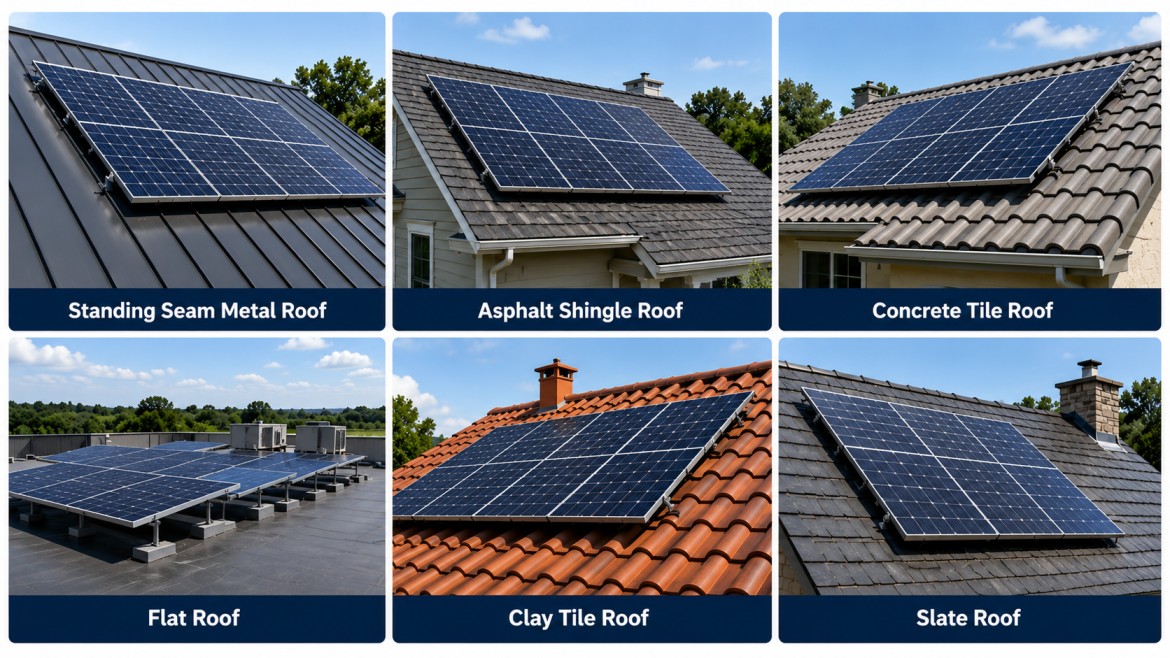
Why Roof Type Matters When Installing Solar Panels on a Roof
When installing solar panels on a roof, many homeowners focus on the solar panels themselves, but the roof type plays an equally important role. Your roof acts as the physical foundation and structural foundation of the entire solar investment. Different roofing materials require different mounting hardware, mounting systems, and installation methods. Choosing the wrong approach can increase the leak risk, lead to voided warranties, create structural failures, and reduce the long-term financial return of your solar system. A proper evaluation of roof compatibility, material compatibility, roof condition, roof structure, and structural integrity helps ensure reliable system performance, smooth solar installation, and long-term value.
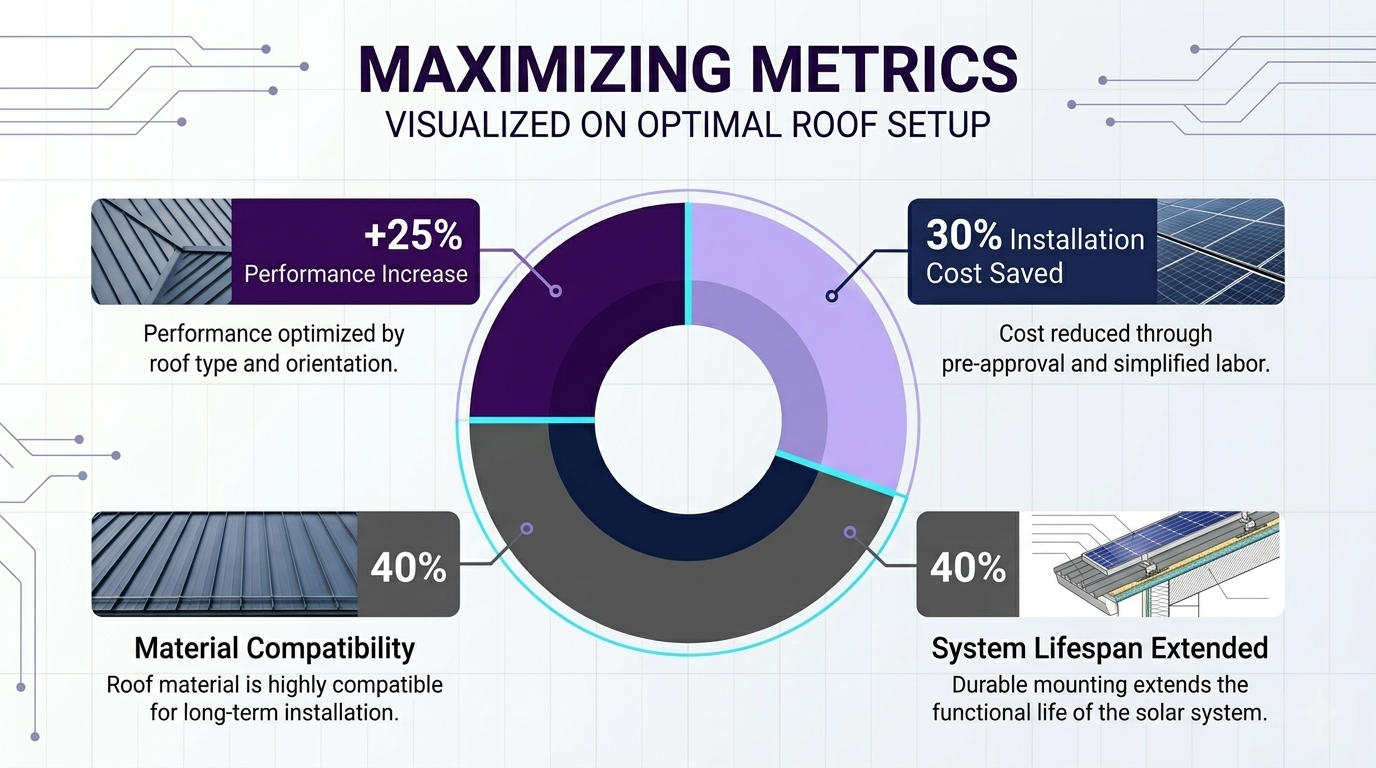
Structural Support Requirements
Before installation begins, the roof must provide enough structural support to handle the additional roof load from a residential solar array. Factors such as load-bearing capacity, live load capacity, dead load, weight capacity, roof framework, rafters, trusses, and overall building structure affect whether a roof can safely support the system. Older homes may need reinforcement, sistering, or additional joists to improve structural strength and system stability. Weather conditions such as snow load, wind uplift, and strong wind forces also influence roof performance, making a professional engineering assessment and structural evaluation important before moving forward.
Roof Lifespan Considerations
A solar system is designed to last for decades, so the roof lifespan should closely match the solar lifespan. If the remaining roof life is too short, homeowners may face costly roof replacement, solar array removal, and solar array reinstallation later. While asphalt shingles may require earlier replacement depending on roof age, metal roofs and tile roofs often provide greater roof durability and roofing longevity. Planning a roofing upgrade before solar installation can improve project efficiency, reduce future maintenance costs, and increase the overall long-term value of the investment.
Installation Complexity and Costs
The level of installation complexity depends heavily on the roofing material and roofing design. Asphalt shingles and standing seam metal roofs are often considered the most cost-effective installation options because they support simpler solar mounting solutions. In contrast, clay tiles, concrete tiles, and slate roofs require specialized equipment, careful handling, and additional labor due to their brittle nature. Flat roofs, including TPO roofs and EPDM roofs, may use ballast systems, weighted racks, or tilt-up racking to achieve the ideal panel orientation. These differences affect installation costs, labor requirements, project costs, and the overall efficiency of the installation process.
1. Asphalt Shingle Roofs and Solar Panel Installation
When it comes to asphalt shingle roofs, they remain the most popular choice for solar panel installations in the United States, covering nearly 80% residential properties. Their widespread use makes them a standard surface and a highly compatible surface for mounting solar equipment. For many homeowners, this roof type is seen as a solar-friendly surface because of its strong roof compatibility, easy installation suitability, and overall role in supporting modern photovoltaic systems within the growing solar market. This strong link between residential roofing, solar adoption, and solar infrastructure makes asphalt shingles one of the most practical options for solar installation surface needs.
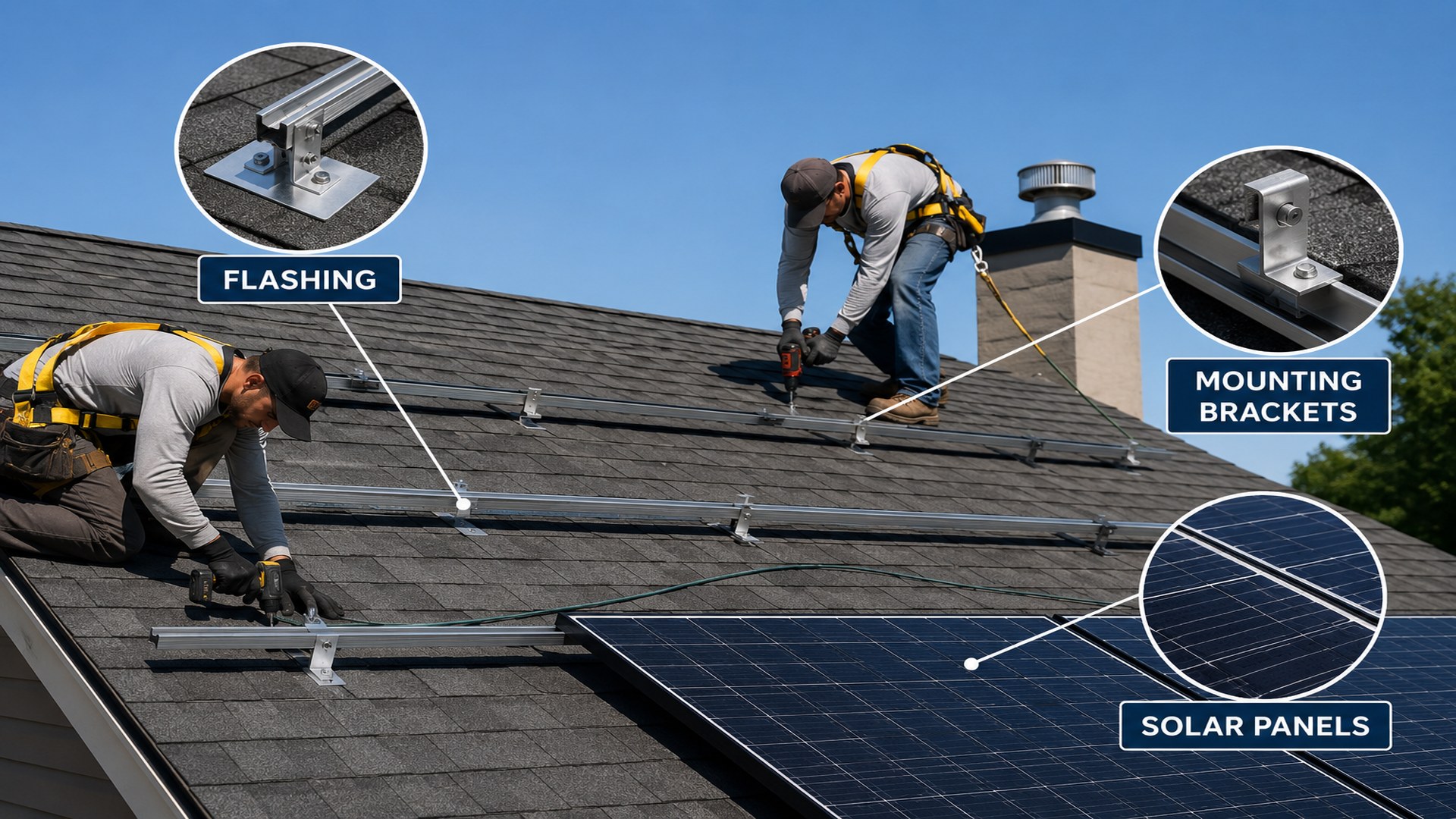
Why Asphalt Shingles Are Solar-Friendly
Asphalt shingle roofs, including standard three-tab and architectural shingles, are one of the most popular choices for solar panel installations. Their affordability and compatibility with standard mounting systems make them a practical option for many homeowners considering solar energy.
The mounting process is simple, with easy penetration, proper sealing, and well-tested installation techniques used by professional crews, helping reduce labor costs while improving installation efficiency. Their durable foundation, solar-ready roof structure, and strong roof compatibility support both residential solar and long-term solar projects, making them a reliable installation standard for modern solar-friendly systems.
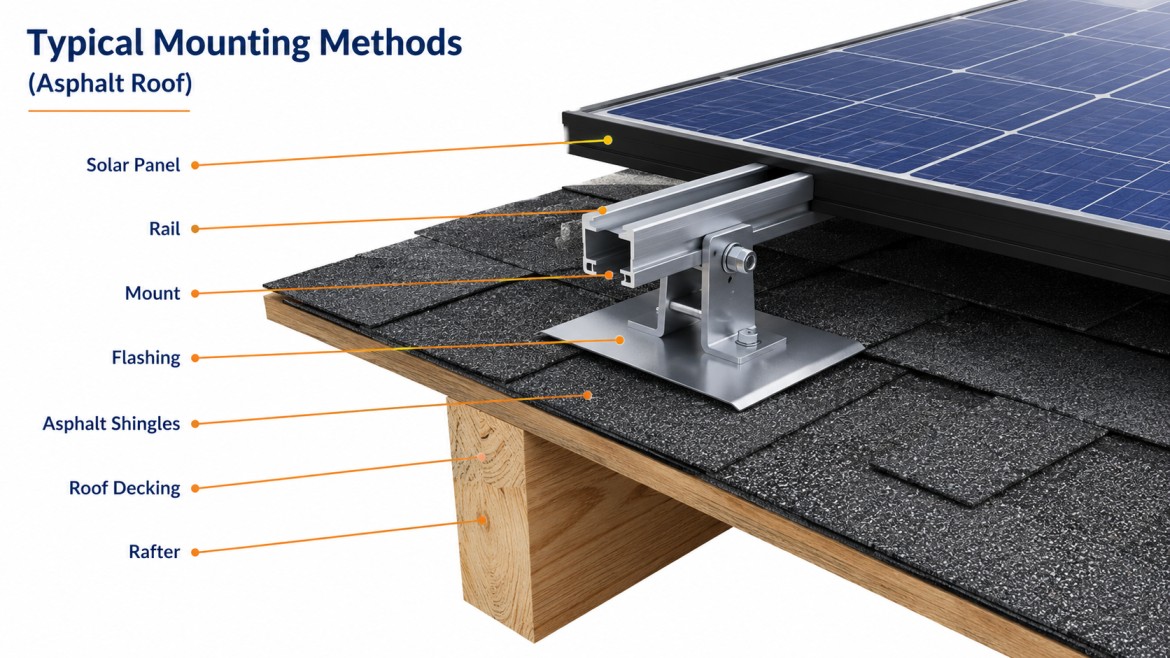
Typical Mounting Methods
The installation process for asphalt shingle roofs follows standardized steps designed for structural security and weatherproofing. Installers use drilling, anchoring, and penetrating mounts secured into roof rafters, trusses, and support beams at proper rafter spacing (typically 16 inches apart or 24 inches apart). Key mounting points ensure proper weight distribution and resistance against wind forces on the solar array. To prevent leaks, flashing with a metal plate is installed at each penetration point, sealed using UV-rated sealants like silicone or tar, creating a strong watertight seal and improving long-term weather resistance.
Advantages
Asphalt shingles are cost-effective, making them the most affordable roofing option for solar installations.
They are easy to repair and maintain, which helps reduce long-term maintenance costs.
They offer good durability along with strong wind and heat resistance.
They also help protect solar panels from UV radiation and harsh weather conditions
Limitations:
Lifespan mismatch between asphalt roof lifespan (15 to 30 years) and solar panel lifespan (25 to 30+ years)
Need for roof replacement, reroofing, and removing and reinstalling panels
Extra reroof cost in future
High heat absorption from direct sunlight
Very high surface temperature up to 150°F
Efficiency loss (about 0.45% efficiency reduction above 77°F)
Reduced solar efficiency and energy output
Risk on older roofs needing structural reinforcement
Increased roof load on aging structures
What Are the Best Solar Panel Kits for Installation on Shingle Roofs?
Not all solar kits are built the same. The best solar panel kits for installation on shingle roofs combine reliable mounting hardware, strong roof protection, efficient power electronics, and high-quality solar panels. A good system should work well with an asphalt shingle roof, provide long-term performance, and support safe installation without increasing the risk of leaks or structural problems.
What Makes a Good Solar Kit for Shingle Roofs?
A quality solar kit starts with a durable racking system and secure mounting framework that transfers the system weight safely into the roof rafters. It should also include metal flashing, UV-rated sealants, and secure module clamps to improve waterproofing, prevent leaks, and protect the roofing structure for years.
Beyond the mounting system, the best kits include efficient monocrystalline panels, reliable microinverters or DC power optimizers, and performance-monitoring features that maximize energy production. Before installation, homeowners should also complete a professional assessment to verify roof age, structural support, and overall roof condition.
What Are the Top-Rated Solar Panel Mounting Systems for Asphalt Shingle Roofs?
Brand | Key Strengths | Best For |
|---|---|---|
IronRidge | XR rail series, durability, installation reliability, ease of use | Pitched shingle roofs and residential solar projects |
Unirac | High-quality kits, structural integrity, wind resistance, installation standards | Long-term residential installations |
SnapNrack | Specialized mounting inserts, watertight fit, secure attachment | Leak-resistant installations on shingled surfaces |
Signature Solar | Mini rail kit, mounting flexibility, DIY applications | Homeowners looking for flexible panel placement |
Essential Components to Look For
Every high-quality shingle roof kit should include:
Standard penetrating mounts secured into the rafters
Metal flashing for waterproofing around penetration points
UV-rated sealants for long-term leak prevention
Module clamps for secure panel attachment
A durable rail system and mounting hardware
Components designed to improve weather resistance and roof protection
Best Solar Panel Kits for Installation on Shingle Roofs
Solar Kit | Best For | System Type | Key Features |
|---|---|---|---|
EcoFlow PowerKits 4800 | Whole-home energy management | Grid-tied + Battery Backup | Smart Home Panel 2, LFP battery, hybrid inverter, energy management system |
Renogy 4000W Monocrystalline Complete | Value-focused homeowners | Grid-tied | MPPT string inverter, Renogy ONE monitoring platform, DIY-friendly installation |
Grape Solar 5.3 kW | Shade-prone roofs | Grid-tied | Micro-inverters, independent panel operation, improved shaded-panel performance |
Rich Solar 3000W Off-Grid Pro | Off-grid homes and cabins | Off-grid | Hybrid inverter, MPPT controller, battery-ready setup |
Bluetti AC500 + PV350 Bundle | Portable and backup power | Hybrid / Portable | Foldable panels, expandable battery storage, flexible deployment |
WindyNation 4500W Complete | Budget-conscious buyers | Grid-tied | Large system capacity, complete mounting hardware package |
SunGold Power 6 kW | High energy production | Grid-tied | Commercial-grade racking, larger system size, net metering support |
Nature’s Generator Powerhouse | Beginners | Hybrid | Plug-and-play design, simple setup, integrated power solution |
HQST 2000W Off-Grid Starter | Entry-level users | Off-grid | Basic off-grid configuration, lower upfront investment |
Goal Zero Yeti Pro | Emergency backup power | Portable Solar Generator | Battery storage, portable design, backup power capability |
2. Tile Roofs
Tile roofs are popular because of their attractive appearance and long lifespan. They can easily support solar systems throughout their 25–30-year lifespan, making them a strong option for homeowners interested in solar energy.
However, solar panel installation on tile roofs is more complex than on many other roofing materials. The fragility of the material and the weight of the tiles mean installers need specialized mounting hardware and experienced labor to complete the job safely.
1. Clay Tile Roofs
Clay tiles are commonly found on Spanish-style homes and offer several unique benefits. They are extremely porous, water-resistant, provide excellent insulation, and can last between 50 and 100 years.
Installation Challenges
Clay tiles present the highest level of difficulty for solar installers. The tiles are very brittle and can easily shatter under the weight of an installation crew if they are not handled carefully.
Mounting Process
Clay tiles are fragile, installers usually avoid drilling directly through them. Instead, they remove individual tiles and attach mounting hooks directly to the roof rafters. The hooks are then covered with flashing, and the tiles are trimmed and slid back into place.
Alternative Mounting Method
Alternative mounting options include:
Metal tile replacement mounts
Clay tiles offer several benefits, but their brittle nature makes solar panel installation more complex and costly.
2. Concrete Tile Roofs
Concrete tiles are a durable and heavy alternative to clay tiles. They can last more than 50 years, perform well in harsh sunlight, absorb less heat than asphalt, and help keep the home's interior cooler. However, they are relatively heavy, typically weighing between 9 and 14 pounds per square foot, while a solar system adds an additional 2 to 4 pounds per square foot.
Mounting Methods
Installers may use comp-outs. This involves removing tiles and replacing them with a small section of composite shingle where the mount will be installed.
Alternative Mounting Option
Specialized racking standoffs may also be used for high-profile tiles.
Common Challenges of Installing Solar Panels on Tile Roofs
✔ Tile roofs can crack or break during installation because the material is fragile.
✔ Roof access is more difficult since installers cannot safely walk on every part of a tile roof.
✔ Installers often need special hooks, flashing, and mounting systems designed for tile profiles.
✔ Creating a watertight seal is more challenging than on many other roof types.
✔ Flashing must be placed beneath overlapping tiles to prevent leaks around mounting points.
✔ The installation process takes longer because tiles often need to be lifted, adjusted, and carefully reinstalled.
✔ Labor costs are usually higher due to the extra time and care required.
3. Slate Roofs
Slate roofs are known for their durability and can often last long enough to support a solar system throughout its lifespan. While it performs well in harsh weather conditions, it is sensitive to installation stress and additional roof loads. For this reason, a professional engineering assessment is often recommended to verify structural integrity and ensure the roof can safely support both the slate roofing material and the solar array.
Installation Method
Instead of drilling directly through the tiles, installers typically use a remove-and-replace approach. Individual slate tiles are carefully removed, mounting hooks are attached to the roof rafters, flashing is installed to prevent leaks, and the slate is trimmed and reinstalled.
Specialized Mounting Options
Common mounting options for slate roofs include:
Non-penetrating brackets
Metal tile replacement mounts
4. Flat Roofs
Installing solar panels on flat roofs is common in modern residential homes, condos, and commercial buildings. These flat surfaces give installers more flexibility in solar panel positioning than pitched roofs, where space is limited by the slope. This allows the ideal tilt and orientation to match the building direction.
Most systems place panels at a 15-degree angle so rain, snow, and debris can slide off easily. However, flat roofs can face wind loading concerns and water pooling around panel bases. Since rain does not always wash debris away like on sloped roofs, more frequent cleaning may be needed to reduce debris accumulation. Proper design helps maintain long-term system performance.
TPO Roofs
TPO roofs (thermoplastic polyolefin) are a single-ply membrane roofing option used in many modern flat roofs and low-slope buildings. This lightweight material offers strong waterproofing properties, making it a safe base for solar arrays. Its white surface reflects sunlight, helping with building cooling and keeping solar panels cooler. This helps improve solar efficiency and energy output compared to darker roofing materials.
EPDM Roofs
EPDM roofs (ethylene propylene diene monomer) use a waterproof rubber membrane and are another popular flat roof option. They are a durable material with a 20–30 years lifespan, often chosen because they are cost-effective roofing. The black surface absorbs more heat, creating a clear thermal difference compared to TPO roofs, but they still work well for solar installations.
Installers usually use non-penetrating mounting techniques to protect rubber membrane integrity and maintain overall roof protection. This makes EPDM highly solar compatible while keeping the roof structure safe.
Ballasted Mounting Systems
Ballasted mounting systems are widely used on flat concrete roofs and rubber roofs. Instead of drilling, installers use a ballast system with weighted racks, often supported by concrete blocks or cinder blocks placed on the roof surface. This weight-based system provides leak protection, ensures zero roof penetrations, and helps protect roof integrity.
However, the system adds a heavy load and increases structural weight, so the roof must be strong enough to handle the ballast, solar panels, and environmental factors like snow load. Proper design ensures the roof maintains enough strength for long-term safety.
How Do You Install Solar Panels on a Flat Roof Safely?
Safe solar panel installation on a flat roof starts with a structural assessment by a professional engineer to confirm the roof can safely support the solar system. Installers also design a proper racking system to maintain roof drainage paths and prevent water pooling, which can cause membrane damage.
The layout must also avoid obstructions like vents, skylights, and exhaust fans. Correct wind engineering is important, and panels are usually set at a 15-degree panel tilt to reduce wind pressure during high wind events. While DIY installation may seem possible, it carries technical complexity, risks in electrical wiring, working at heights, and may even affect roof warranties, so professional installation is always safer.
5. Wood Shake Roofs
Wood shake roofs are often chosen for their aesthetic appeal and natural insulating properties, but they are also considered one of the most problematic surfaces for solar panel installation. While it is possible to mount solar panels on wood roofs, the process comes with several structural, safety, and financial challenges.
Installation Challenges
One major issue is extreme brittleness. The fragile material can suffer cracking or shattering under the weight of installation crews, making the work more labor intensive and increasing the overall cost. In addition, fire risk, regulatory restrictions, insurance limitations, high maintenance requirements, and issues such as rot can make solar less practical on these roofs.
Mounting Challenges
Unlike flat asphalt or smooth metal roofs, wood shakes have an uneven texture that makes it harder to create a stable mounting base and a reliable watertight seal around mounting hardware.
Mounting Process
The installation process often involves drilling into roof rafters or roof decking and installing metal flashing for leak prevention. However, mistakes during installation can damage the surrounding shakes.
Alternative Options
Many solar companies recommend replacing a wood shake roof before solar installation. Common reroofing options include:
Asphalt shingles
Metal roofing
Alternative Solar Solutions
If roof installation is not possible, homeowners may consider:
Ground-mounted solar systems
6. Metal Roofs
Many solar professionals consider metal roofs one of the easiest and most reliable roofing materials for solar panel installation. Their durability, long lifespan, and solar-ready design make them highly compatible with solar systems. Metal roofing can last 40–70+ years and is also a lightweight roofing material, helping reduce structural strain.
Installation Methods
The installation approach depends on the roof design. Standing seam roofs support non-penetrating mounting, while corrugated roofs and trapezoidal rib roofs typically require drilled mounts and sealants to create a watertight finish.
Standing Seam Roof Mounting
Standing seam roofs use:
Specialized U-clamps
Seam-mounted brackets
These systems attach directly to the raised seams, allowing zero drilling and zero roof penetrations.
Alternative Mounting Options
Other mounting options include:
Drilled mounts
Galvanized screws
Tile replacement mounts
Performance Benefits
Metal roofs provide several performance advantages, including:
Thermal reflectivity
Sunlight reflection
Heat reflection
Improved attic cooling
Better air circulation beneath solar panels
Thin-Film Solar Options
Specialized solar options include:
Thin-film solar
Thin-film solar panels
These systems may use adhesive installation methods that require no racking or clamps.
Environmental Benefits
Metal roofing supports sustainability through:
Recycled materials such as aluminum
100% recyclability
Reduced carbon footprint
Potential contribution toward LEED certifications
Solar Panels on Metal Roof Cost
The cost of installing solar panels on a metal roof depends on factors such as system size, roof type, and household energy needs. Based on 2026 estimates, an average 6kW solar system costs approximately $19,140, or about $3.03 per watt before incentives. After applying the 30% federal solar tax credit, many homeowners pay between $10,000 and $30,000.
Metal Roofing Material Costs
Typical metal roofing material costs include:
Standard corrugated steel: $7–$14 per sq. ft.
Standing seam metal: $12–$30 per sq. ft.
Stone-coated steel: $10–$18 per sq. ft.
Combined Roof and Solar Project Cost
For homeowners installing a new metal roof and solar system together, bundled project costs for an average-sized home generally range from $25,000 to $45,000+.
Factors That Affect Installation Cost
Several factors influence the total installation cost, including:
Solar system size
Metal roof type
Labor requirements
Mounting equipment
Racking equipment
Permitting and installation costs
Which Roof Type Is Best for Solar Panels?
Standing seam metal roofs are widely considered the best roof type for solar panels. Their durability, long lifespan, and non-penetrating mounting systems allow solar panels to be installed without drilling into the roof, reducing the risk of leaks and helping preserve roof integrity. They also typically last longer than most solar systems, making them a highly compatible and cost-effective option for long-term solar installations.
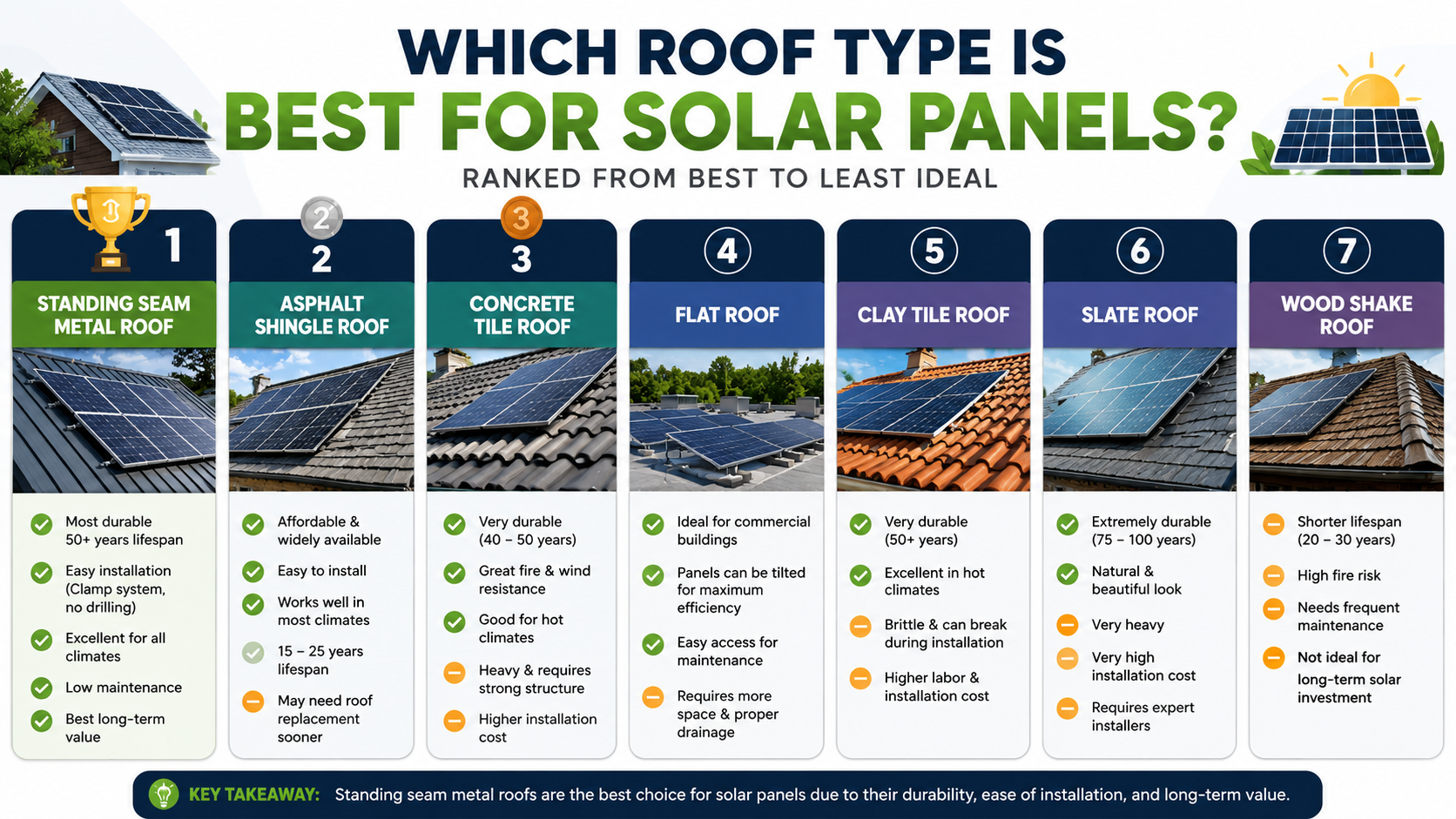
What Type of Roof Is Not Good for Solar Panels?
Roofs that are heavily damaged, structurally weak, heavily shaded, or made from fragile or flammable materials are generally not ideal for solar panel installation. Common examples include:
Wood shake roofs
Cedar shake roofs
Slate roofs
These roof types can create safety concerns, increase installation costs, reduce energy production, and may require roof repairs or replacement before solar panels can be installed.
Factors That Affect Solar Installation on Any Roof
Roof Type and Roofing Material
Different roofing materials require different installation methods, which can affect project complexity, cost, and long-term performance.
Structural Integrity and Weight Capacity
Your roof must be strong enough to support the added weight of solar panels as well as environmental loads such as wind and snow.
Roof Age and Remaining Lifespan
If your roof is nearing the end of its lifespan, replacing it before installing solar panels can help you avoid costly removal and reinstallation later.
Roof Orientation
The direction your roof faces has a major impact on energy production. In the Northern Hemisphere, south-facing roofs typically receive the most sunlight throughout the day.
Roof Pitch (Slope)
Roof pitch affects both solar output and installation safety. Moderate slopes often provide better conditions for solar panel placement than very steep roofs.
Shading
Shade from trees, chimneys, vents, or nearby buildings can significantly reduce the amount of electricity your solar panels generate.
Available Roof Space
The amount of usable roof space determines how many solar panels you can install and how large your solar system can be.
Every roof is different. While many roofing materials can support solar panels, the best results usually come from matching the mounting method, roof condition, and system design to the specific roof structure.